On a dark shirt, colored ink on its own sinks into the fabric and goes dull. The fix is a white underbase: a layer of white printed first and flashed, with the colors printed on top of it. It is one more screen, and it is the screen most likely to cause a white halo, a chalky black or a print that feels like a plate. This is how to get it right.
What the underbase does
The white gives the colors a light ground to sit on, so a red reads as red and not as maroon. The usual order is underbase, flash, then the colors. A highlight white, if the design has one, is a separate screen that prints near the end to put back the brightest whites.
Why transparent inks fade into a black shirt, and what opaque ink over white gives back, after Josef Albers (more video lessons):
How heavy it should be
At every point in the design, the white should be at least as heavy as the heaviest color going over it. If the white is thinner than the color on top, the shirt shows through wherever the color does not fully cover.
Black is the exception. Black ink already reads dark against most shirts, so a full-strength white under it burns white ink and adds bulk for nothing. In a CMYK underbase Halftoned takes black at 85% of its strength. That figure is a judgment call, not a measured constant: if your blacks look chalky, it is the number to suspect.
Where the shirt is meant to show, give it no white at all:
- Black areas on a black shirt. The shirt is the black. Large black areas need no ink and no underbase.
- Tints the ink and shirt make on their own. A 50% black on a black shirt, or a gray made from the white ink, needs no white in its gaps. White there makes those tints print far too light.
- Photo shadows in simulated process. The shadows are made by the shirt showing between the dots. White under them lifts what was meant to stay dark.
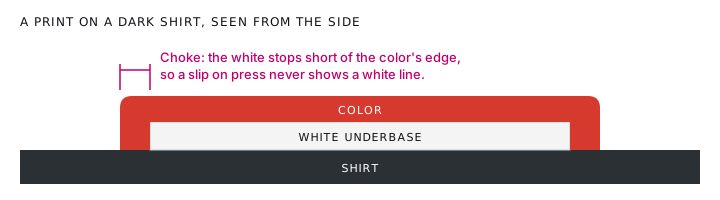
Choke: pull the white back from the edges
No press registers perfectly. Shift the color screen a hair and a white line appears along the edge of the design, where the underbase peeks out from under it. A choke pulls the white inward from every edge so that drift is absorbed instead.
| Choke | On the print | At 720 dpi |
|---|---|---|
| 0.5 pt | 0.18 mm | 5 film pixels |
| 1 pt | 0.35 mm | 10 film pixels |
| 2 pt | 0.71 mm | 20 film pixels |
One point (1/72 inch) is a common starting choke, and it is Halftoned's default. Go to 2 points on a press that drifts. Measure the choke on the print, from the edge of the ink, not in pixels of the artwork: a 1-point choke on a 300 ppi file and on a 72 ppi file should look the same on the shirt.
The choke also works at the outer edge of the design. A design with a flat band of color shows a thin margin of no white at the band's edge once the choke is on. That is correct.
Halftoning the white
A white with tones in it is halftoned like any other screen, so it needs an angle that stays clear of the colors. In a CMYK set Halftoned puts the underbase at 37.5°, which is 15° or more from every process color and off the mesh weave. In spot and sim process jobs it shares the spread of angles with the inks. See halftone angles and moiré.
By separation type
- Spot color. White under solid color. Into the gaps of a tint only where the artwork is lighter than the ink and the shirt can make on their own.
- Simulated process. The separation decides, pixel by pixel, how much of the gap between dots is bare shirt and how much is white. See simulated process on dark shirts.
- Index. White under every dot. An index cell is either solid ink or bare, so there is no gap for white to show in.
- CMYK. White as heavy as the heaviest of the four inks, with black discounted, then choked.
Check it before you burn
Look at the separation over the shirt color with the underbase on. If the proof looks like the artwork, the white is doing its job. If whites show along edges, choke more. If the darks look washed out, there is white under something that should be shirt.
In Halftoned
Pick a dark garment and the white underbase is built from the separation, choked by 1 point, on its own film with the same registration marks as the rest. The proof shows the colors on the white over the shirt color. See the preview or the pricing.