Two colors that meet exactly in the artwork will not meet exactly on the shirt. Screens flex, pallets shift and shirts stretch. Without a trap, a hairline of bare shirt shows at every color boundary. A trap overlaps the colors slightly so a small slip is hidden instead.
Spread and choke
- Spread grows an ink outward, under the neighbor that prints after it. It is the usual choice.
- Choke pulls an ink back from its edge, so the ink underneath fills the gap. It is used on the white underbase, and where a light ink has to print on top of a darker one.
- None leaves an edge exactly as drawn, for colors that do not touch anything.
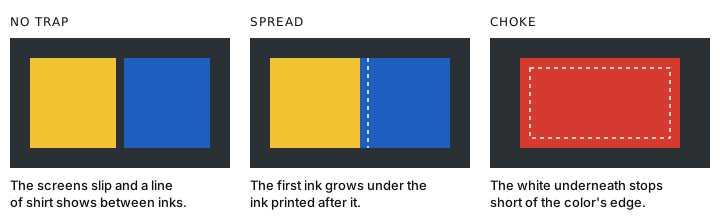
How much
Common traps are small: half a point to a point on most presses (1 point is 1/72 inch, about 0.35 mm). Go wider on a manual press or stretchy garments, narrower on a tight automatic press with fine detail. A trap you can see on the finished print is too wide.
Print order decides who spreads
A spread should run under the ink printed after it, never over one printed before it, and never into bare shirt. So the print order is part of the trap:
- Light colors print first and spread under the darker ones that follow.
- Dark colors and outlines print last and sit on top, so their edges stay sharp.
- Where a light ink must sit on top, choke it instead.
Change the print order and the traps have to follow.
The underbase is a trap too
On a dark shirt the white underbase is choked inward from every edge, so a slip of the color screens never lets white peek out. That choke is set separately from the color traps. One point is a common start. See white underbase for dark shirts.
Fine black detail
Fine black lines and small type inside a colored area are hard to trap. Knocked out of the colors, they fill in when the colors spread. A common fix on dark shirts is to print that detail as its own black screen, last, on top of the colors with a small trap and no white under it. The same move is used in simulated process on dark shirts.
Halftones do not need much trap
Where two halftoned inks overlap they already mix, so they need little or no trap. Trapping matters most at the edges of solid color, which is spot color's territory: see which separation to use.
Check it on the proof
Zoom into a few color boundaries before you burn. You should see the lighter ink running under the darker one, never a gap of shirt and never a light ink over a dark outline.
In Halftoned
Each spot ink is Spread, Choke or None, with a trap amount (0.5 point by default). The ink list is the print order, and a spread only runs under inks printed after it, never into bare shirt. On a dark shirt Halftoned suggests a detail-black screen when the art has enough fine black inside color. See the preview or the pricing.